


> LTPA and OLTPA: a substantial additional workload for financial intermediaries
> Revised AMLA: advisory activities become subject to AML obligations
TRANSPARENCY REGISTER
Federal Act on the Transparency of Legal Entities (LTPA) and its Ordinance (OLTPA): Introduction to the new transparency register – What’s new and what does it mean?
- Scope of applicability: Who is subject to the new regulation and who is not?
- Ultimate Beneficial Owners: Who falls within the scope of the new (and broadened!) definition of UBOs? What are the consequences of the amended UBO concept?
- Companies’ obligations: Gathering information on UBOs and the (entire) control chain – how much information is enough? Who can benefit from certain simplifications?
- Shareholders’ and UBOs’ obligations: Who notifies whom of what? What happens if one doesn’t?
- Trusts: How are trusts captured by the new regulation and what differs compared to the CDB?
- Register: How is the register organized? Who has access to it?
LTPA and the OLTPA: What will be the impact on financial intermediaries ? Why could the workload be substantial ?
- Additional workload for from divergence notifications
a) Distinguishing reportable divergences from exemptions; challenges posed by new definitions
b) Identifying divergences
c) Contacting the client: clarifications and (non-)cooperation
d) Reporting the divergence: practical guidance and open questions, particularly where the UBO is not registered; “justification of the divergence”, notably the nature and extent of control exercised by one or more UBOs - A de facto obligation to consult the register?
No formal duty to consult the register, but a practical expectation from the authorities? - Quasi-obligation to identify and verify UBOs by other means
The LTPA requires both ownership-based UBOs and UBOs exercising control “by other means” to be entered in the transparency register, unlike the CDB, which follows a cascade approach. Where UBOs are recorded “by other means”, intermediaries must analyse them carefully. - Handling authority-annotated divergence notifications from other financial intermediaries
- What information will be visible (e.g. doubts as to accuracy, completeness or currency)?
- How will annotations be reflected: communication to the entity by the register authority? Public visibility in the register for other intermediaries?
- KYC documentation
Must it be recorded that Swiss or foreign entity clients are subject to UBO reporting obligations? Is ongoing monitoring of compliance required?
REVISED AMLA
The Revised AMLA – Advisory activities become subject to AML obligations: What Impact for banks and the other financial intermediaries?
- Advisory activities covered: sale or purchase of real estate; creation and management of a company, foundation, or trust; structuring of capital contributions to a company; acting as a nominee shareholder.
- Advisers’ due diligence obligations and organizational measures: verification of the client’s identity; identification of the beneficial owner; establishment and retention of documentation; reporting to MROS.
- Advisory activities carried out by a financial intermediary and coordination of monitoring responsibilities.
- Banks’ duties vis-à-vis advisers, whether acting as counterparties or as clients.
SPEAKERS
Dr. Linus Zweifel, Attorney-at-law, Senior Associate, Bär & Karrer Ltd, Zurich
Thomas Nagel, Partner, Dr. iur. | Attorney at Law, Advoro Zurich Ltd
Remo Schmidlin-Lolli, Associate Attorney-at-law, Lenz & Staehelin, Zurich
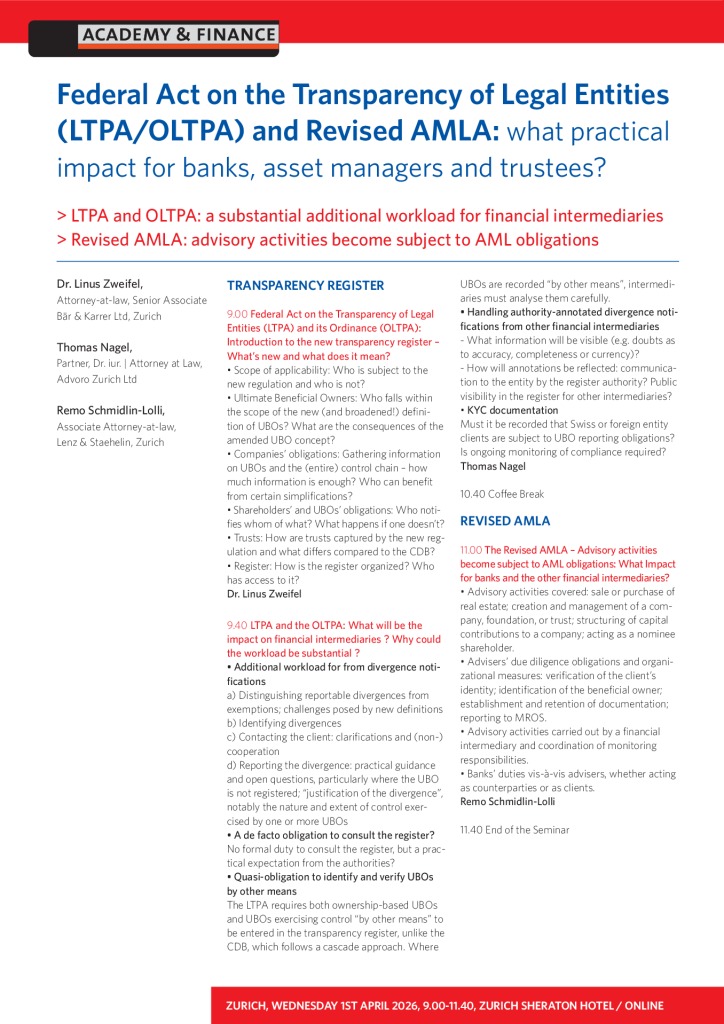
Federal Act on the Transparency of Legal Entities (LTPA/OLTPA) and Revised AMLA: what practical impact for banks, asset managers and trustees?
I wish to see this past conference on zoom
Contact by the phone
ACADEMY & FINANCE SA
Rue Neuve-du-Molard 3
1204 Genève
Switzerland
T + 41 (0)22 849 01 11
E info@academyfinance.ch